



People need privacy for lots of reasons, where nothing seems to be better than privacy screens. They can provide a pleasant aura in the dining sessions, especially in gardens and lawns. In bedrooms where people need a changing area without expanding the space, these privacy screens fulfill their needs. A privacy screen exporter can provide customized designs, colors, materials, and sizes to precisely satisfy customers. Some manufacturers have standard production, and some can unlock customized production. It all depends on who you choose. DuraLink Fencing is one of the ideal manufacturers you can try. What makes its privacy screens better is the durability, design, color, and variety they offer.
Both residential and commercial users like to install them, which is why many go for bulk privacy screens. Find out what they are and how they change the appearance of any place. If you are a retailer or commercial user, this blog could make you try them. In this modern age, people like to keep their places simple, and privacy screens can help them do so.
There are two types of privacy screens, and the one we are talking about is like room dividers. They are large vertical wall-like panels that help to hide by covering that specific spot. There are like room fences that create privacy. This is why they are called privacy screens or privacy fence screens.
Privacy screen hex cubed is one of the best examples of it. It can provide privacy and also beautification wherever you place it. Whether it is a pool area, hot tub, garden, backyard, or balcony, it can work for all outdoor spaces. Also, it is best for indoor applications like changing clothes, seclusions, creating more office spaces, and private settings in restaurants.
There are multiple types of materials that are popular in the production of privacy fence screens. Those materials provide every advantage users seek from these privacy fence screens. Visibility blockade, noise reduction, efficient airway, and beautiful appearance are the objectives for every privacy screen distributor. Whether it is a modern or a privacy screen vintage version, the following privacy screen materials are preferred for residential and commercial use.
Wood is a versatile, beautiful, and durable material for outdoor and indoor privacy screens. It can survive in dry weather against medium and high UV exposure. Bamboo, cedar, and redwood are common types used in the production. Some of them require protective coats against moisture and insect attack, like termites. Wooden panels with each metallic privacy screen post provide an aesthetic appearance. Wooden lattice style is a popular choice in many residential and commercial settings.
Then there is the metallic option, which does not degrade against UV rays. Privacy screen moderna is a good example of it. It can show good resistance to UV rays’ absorption through white coats. All it requires is an anti-rust coating for moist conditions. However, both aluminum and stainless-steel privacy screens are already water-resistant. Aluminum is a lightweight solution that is also more affordable than SS. Privacy screen distributors have varieties like theirs to meet global needs.
Every privacy screen distributor has varieties like these to meet all the buyers’ requirements. This is why the next is plastic, where HDPE, vinyl, and acrylic are popular options. They are a lightweight choice with good UV resistance. Also, they have fewer or even no maintenance needs. The best part about the plastic privacy screens is that they are water-resistant, which makes them suitable for poolside installations.
Some people install them permanently, and some go for temporary use. People who have to change the indoor or outdoor settings often go for a temporary installation type. Also, people who switch the position of screens based on the direction prefer movable ones. Here are those options.
People choose surface-mounted privacy screens near pools, patios, and in commercial places. These types need screws for the permanent positioning, where one does not need to change the position again. Restaurants, cafes, and offices also prefer bulk privacy screens for permanent settings.
This one has flat feet or swivel wheels for frequent displacements. People who need to often move privacy panel screens prefer this type. Home users choose them for both indoor and outdoor use and a single unit is enough sometimes. Even doctors use them during medical checkups and therapy sessions to provide a patient's privacy from other patients.
Both are primary applications, and people use them because of this versatility. When retailers or commercial users choose a privacy screen distributor, they have to share the purpose of using them. If the privacy screens are for privacy, their visibility factor, thickness, and dimensions matter a lot. Larger, thicker, and small-aperture types are ideal for privacy purposes. For instance, privacy in gardens, backyards, hotels, motels, restaurants, and clinics requires less visibility and more noise blockade.
While the ones for decoration have more emphasis on their appearance, such as design and color. People choose them for decoration with plant vines, ribbons, and flowers. One of the most famous reasons why people choose them is for a backdrop in gardens, weddings, and events.
Yes, they are not only suitable but are already widely used in commercial settings. Businesses procure bulk privacy screens for events like weddings, corporate events, and birthday parties for various reasons. These privacy screens provide a backdrop for the wedding couple. Also, they offer a beautiful base for flowers, plant vines, and balloons.
Besides, they are very useful in clinics, hospitals, massage centers, and chiropractic centers. One of the largest uses is in offices, especially for shared office spaces. Restaurants use privacy screens for family dining, especially for couples.
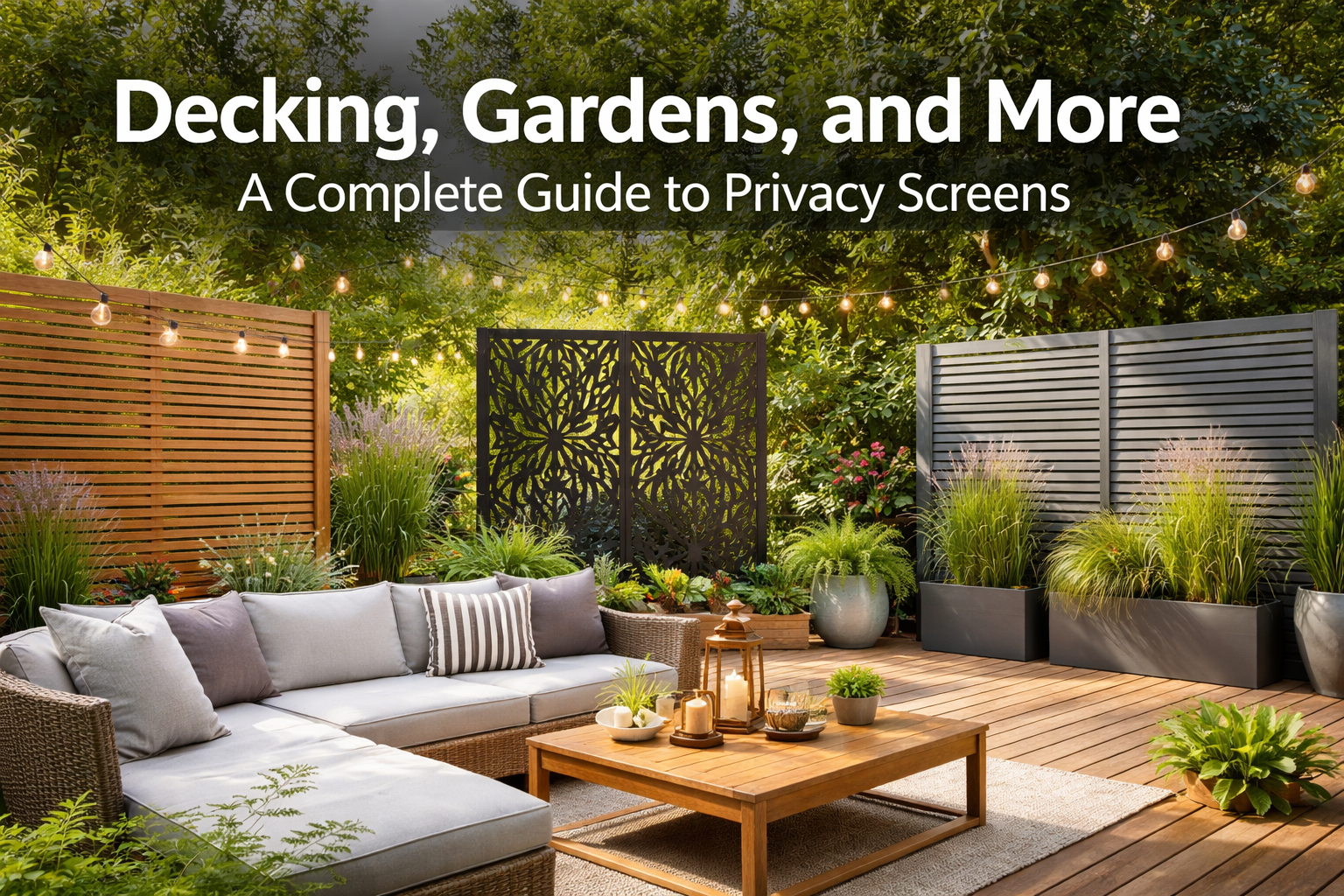
They amplify the beauty of gardens, patios, and backyards. People who dine or have tea in their gardens use these privacy screens for aesthetic background. Privacy screen distributors have lots of designs and custom themes for residential use. Many people use them in their backyards, especially for BBQ gatherings. People use permanent privacy screens in their pool areas.
Yes, it takes just a few efforts to clean and maintain them. Weekly cleaning with a soft, damp cloth prevents dust buildup on them. People also renew the protective coats on wooden ones, mostly to prolong their durability. They are easy to repair through welding and carpentry work.
Here is the question that might be wandering in everyone’s mind. Does rain damage metallic and wooden privacy screens in permanent outdoor installations? It depends on the quality and type of material you choose. Aluminum, stainless steel, cedar wood, redwood, HDPE, and PVC can survive the best in outdoor conditions. They can withstand UV rays, rain, snow, and winds for a long time. A privacy screen distributor knows about it, and buyers have to choose accordingly.
Besides, users have to keep them in good shape by preventing physical damage from pets and kids. Also, periodic coating against moisture and UV rays can keep the durability consistent. One can not just leave them on their own without doing basic maintenance.
It depends on their structures, dimensions, and patterns. Some have shorter heights, and some have taller heights. Also, the aperture size contributes to the airflow and natural light allowance. If the aperture is too small, it will reduce the airflow and light.
However, one can not expect them to block airflow and natural light more than a little. Privacy screens can block light and air only as much as they occupy the space. The rest of the open area around them is there to allow air and light. You can say that they reduce very limited airflow and natural light, depending on their sizes and structures.
It all depends on the material, structure, and environmental conditions. Also, how many people maintain them contributes to it. Some last up to 3 or 5 years, and some last for even decades. Plastic privacy screens like HDPE ones can last longer, especially in outdoor installations. They can survive UV rays, rain, and impacts longer than other types of plastics.
Wooden privacy screens of bamboo, cedar, and redwood can last between 2 and 10 years. It depends on the quality, protective coats, environment, and maintenance frequency.
If we look at the longevity of metallic privacy screens, they last the longest. Aluminum and stainless-steel privacy screens can last over twenty years easily. These metals are resistant to impacts, UV rays, and rust, which is why they last the longest.
Usually, their primary objective is to reduce visibility for privacy, but they also offer some noise reduction. Privacy screens can reduce noise between 6 decibels and 10 decibels, which depends on their thickness and height. The larger the area they cover, the more sound they reduce. Besides the type of material, its height, and its thickness, the aperture size matters a lot.
Keep it in mind that it is not a noise suppression solution. A privacy screen is not an alternative to acoustic panels. If you want to suppress echo and block noise, install acoustic panels for quiet rooms.
Homes, offices, clinics, and restaurants need privacy screens for one primary purpose. The purpose is to provide privacy by hiding a specific area with the help of solid panels. These solid panels are known as privacy screens. They can provide privacy and backdrop aesthetics together. Therefore, many people install them in their gardens, backyards, balconies, and terraces. Besides, they are an ideal choice for hotels, restaurants, and homes for placement in bedrooms and dining areas for private sections. Even event management firms use them in weddings and corporate events for floral backdrops.
Good-quality, solid fencing is essential to commer
READ FULLPeople love to beautify their homes, and if it brings extra protecti
READ FULLWhen a chain link fence fails, most people blame the wire. They shou
READ FULL