



When a chain link fence fails, most people blame the wire. They shouldn't. In the majority of cases, the real culprit is a small, overlooked piece of hardware probably a cap that was skipped, a band that was undersized, or a latch that wasn't rated for the job. The fabric gets all the attention, but the accessories are what hold everything together.
This blog is written for those who want fencing that lasts, performs, and holds up to the constant harsh outdoors exposure. You don't need to become a fencing contractor to read this. You just need to know what to ask from the Fence Accessories Exporter, and what to avoid based on usage scenarios. Here we will uncover why each component matters to the long-term value of your project.
A chain link fence is not just fabric and posts. It is a fully integrated system where every component relies on the others to perform. Think of it the way you would think of a structural wall; the bricks get noticed, but it is the mortar, and the anchoring that determine whether the wall stands for five years or fifty.
Post accessories are like the glue that holds everything together. They transfer load, manage tension, protect against corrosion, and keep every element aligned over time. When they are specified correctly and installed to standard, the entire fence performs as designed. When they are cut from the budget or swapped for cheaper alternatives, the consequences mean a fence that collapses in a short time.
Post caps are often the first thing cut from a budget when someone is looking to trim costs on a fencing project. That decision tends to be regretted.
A post cap fits over the open top of a terminal or line post and seals it against moisture, debris, and standing water. Steel posts are hollow. Without a cap, rainwater collects inside, accelerates rust from the inside out, and compromises the post's structural integrity long before any surface corrosion becomes visible. By the time the damage is obvious, the post often needs replacing entirely.
Post caps come in several configurations. Dome caps and flat caps are the most common for standard line posts. Loop caps are used when barbed wire or top tension wire needs to pass through or attach to the post. Each type is sized by the post's outside diameter this matters more than most people realize. A cap that does not fit snugly is nearly as bad as no cap at all, since water will still find its way in.
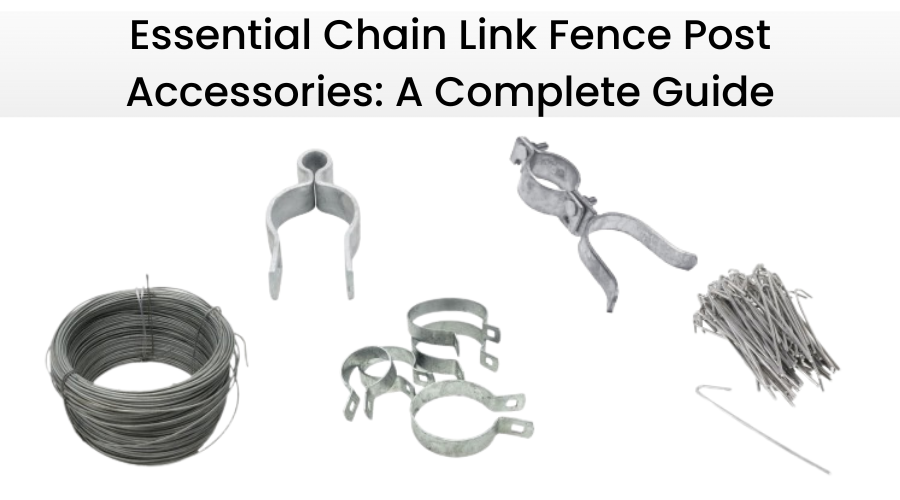
Tension bands are the hardware that connects the chain link fabric to the terminal posts the corner posts, end posts, and gate posts that anchor the fence at its structural transition points. They wrap around the post and hold the tension bar, which in turn holds the fabric. Without them, there is no way to keep the fabric pulled taut against the post.
The number of tension bands required depends on the fence height. The industrial standard is one tension band per foot of fence height. A six-foot fence needs six tension bands per terminal post. This is not an arbitrary number but follows the load distribution requirement. Fewer bands mean each remaining band carries more stress, and stress concentrations in metal hardware lead to deformation and eventual failure.
Material grade matters significantly here, particularly for commercial projects so you need to source these accessories from a reputed fence accessories distributor. Residential-grade tension bands are thinner and lighter. They are appropriate for a backyard fence. They are not appropriate for a warehouse perimeter, or a multi-family residential development where the fence is a security asset. Specifying commercial-grade, heavy-gauge galvanized tension bands upfront is a straightforward way to protect the structural performance of the entire fence line.
Brace bands hold the rail. These are the fittings that secure the horizontal brace rail to the terminal post, and they work in coordination with rail ends to form the complete bracing assembly. With these supporting components, the terminal posts remain upright and do not lean inward under the constant pull of a tensioned fabric.
Brace bands are typically installed near the top of terminal posts, and on taller fences or longer runs, at a mid-point as well. Their job is lateral stability. In simple terms that means resisting the inward force that fabric tension exerts on the post over time. On flat, open commercial sites where fence runs are long and wind loads are significant, this bracing becomes even more critical.
There is a common misconception that brace bands and tension bands are interchangeable because they look similar. They are not. Each is engineered for a specific load direction and attachment point. Using one in place of the other, or omitting brace bands to save time during installation, leads to a problem that worsens progressively and is difficult to correct without dismantling the fence section.
Rail ends are pressed steel fittings that cap the end of the top rail and bolt directly onto the brace band at the terminal post. They are the mechanical connection between the horizontal structure of the fence which is the top rail and the vertical anchor of the terminal post.
They are small and inexpensive, but their role is greater than their size. A rail end that does not fit the top rail's outer diameter precisely will work loose under movement and vibration. A rail end made from a different metal than the brace band it bolts to will corrode at the joint, weakening the connection over time. So, you might need to look at the specs before you hastily place a fence accessories bulk order that results in regret.
Tension bars are flat steel bars that are woven vertically through the end selvage of the chain link fabric before the fence is installed. Once in place, the tension bar is what the tension bands actually grip. It is the interface between fabric and post, and it is what allows the fabric to be pulled tight without the individual wire links taking the full strain.
The tension bar distributes the pull of the fabric evenly across its entire length. Without it, the tension load would accumulate at individual wire intersections. The result would be an unevenly stretched fabric that causes stress on the post. A properly installed tension bar keeps the fabric face flat, and the attachment secure.
Sizing of the tension bars also plays a crucial role in holding the fabric. It must correspond to fence height, and a tension bar needs to run the full height of the fabric to do its job. Gauge matters too. For fences over six feet, particularly in commercial settings where fabric tension is higher and wind loads are greater, heavier gauge tension bars are the right call.
The bottom edge of a chain link fence is its most vulnerable point. Left unsecured, fabric can be lifted, pushed inward, or pulled outward by foot traffic, animals, or simple shifting of the soil. Tension resolves this stability issue.
Tension wire runs along the bottom selvage of the fabric and is attached to the line posts at regular intervals. It functions as a flexible but firm anchor, keeping the bottom edge of the fabric in contact with the intended line and preventing unauthorized lifting or casual displacement. On commercial security perimeters, bottom tension wire is frequently a compliance requirement, not an option.
Not every fencing project starts with open ground. Commercial fencing is frequently installed on paved access roads, or hardscape surfaces where breaking out concrete to embed posts would be labor-intensive and disruptive. Post anchors solve this problem.
Post anchors are surface-mounted hardware systems that secure fence posts directly to existing concrete without the need for full embedment. They come in several configurations: surface mount plate anchors, drive anchors, concrete sleeve anchors, and bolt-down systems. Each variant is suited to different surface conditions and load requirements.
The critical factor when specifying post anchors for a commercial application is load rating. Every anchor has published pull-out and shear strength values, and those values need to be matched against the fence's calculated wind load for the site. This is not a step to skip or delegate entirely to a contractor without oversight. An anchor that looks right but is not rated for the load will fail and in a commercial context, that failure carries liability implications beyond just the cost of repair.
Every other component in a chain link fence system is largely static. Once installed, it sits under steady load and does its job quietly. Gate hardware is different. Hinges cycle open and closed. Latches engage and release. Closers activate on every pass. In a commercial setting such as a warehouse entrance, a construction site gate, a facility with regular vehicle or pedestrian access, this hardware may see hundreds of cycles per week. That frequency of use is why gate hardware deserves more specification attention than it typically receives.
Hinges need to be selected based on the weight of the gate and the anticipated use frequency. Wrap-around hinges distribute load across the full post connection and are preferred for heavy commercial gates. Bullet hinges are faster to install but less robust under sustained heavy use. Either way, the hinge must be rated to carry the gate’s weight across thousands of cycles without deforming or loosening.
The latch is the primary security closure on any gate. Fork latches and key-lockable gate latches are the standard configurations, and for commercial applications, specifying a latch with a padlock hasp or an ANSI-rated locking mechanism is worth the marginal cost difference. Gate keepers are used to hold double gates in alignment at the centre. Theiir main job prevent sagging and wind movement when gates are closed.
Gate closers, spring-loaded or hydraulic, return the gate automatically and matter enormously in any access-controlled environment where an open gate is a security or safety liability.
Gate hardware is governed by ASTM F900, which establishes performance requirements for chain link gate fittings. Specifying hardware that meets this standard is the most straightforward way to ensure you are getting commercial-grade performance rather than residential-grade hardware dressed up in similar packaging.
Tie wires and hog rings are the fasteners that attach the chain link fabric to the top rail and line posts. They are small, inexpensive, and easy to dismiss as minor details. They are not minor. Without adequate tie wire spacing, the fabric is only loosely attached to the rail and post structure, and what looks like a fence is really just fabric held at its ends.
Tie wires are aluminum or galvanized wire lengths that are bent and twisted around both the rail and the fabric mesh. Hog rings are pre-formed rings crimped with a specialized tool, which makes installation faster on large projects. Both perform the same function, and both need to be installed at the correct intervals. The standard practice is every 24 inches along the top rail and every 12 inches at terminal post connections, in line with ASTM F567 installation standards.
Aluminum tie wires on galvanized fabric are the recommended pairing. Mixing steel tie wires with galvanized fabric or using mismatched metals at these connection points introduces the same galvanic corrosion risk.
|
# |
Decision Factor |
What to Assess |
What to Specify |
|
1 |
Fence Height & Fabric Gauge |
Know the fence height. Know the fabric gauge. These two facts drive the rest. |
Specify the tension bar length and gauge. Use one tension band per foot of fence height on each terminal post. State the tie wire spacing. |
|
2 |
Environmental Exposure |
Ask where the fence will live. Coast. Industrial yard. Inland suburb. Moisture, salt, and corrosive air matter. |
Use galvanized steel for standard inland jobs. Use aluminized or vinyl-coated parts where salt or chemicals are in the air. |
|
3 |
Security Requirements |
Decide what the fence must do. Dress the site. Stop intruders. Both. Also ask if lifting the fence is a real risk. |
Specify heavy-duty gate hardware rated to ASTM F900. Add a bottom tension wire or bottom rail. Use a lockable latch with a padlock hasp at secure access points. |
|
4 |
Surface & Ground Conditions |
Look at the ground first. Open soil is not concrete. Flat land is not a slope. Uneven ground changes the work. |
Use full post embedment in open ground. Use ICC-ES certified post anchors on concrete or paved surfaces. Add brace bands on slopes or long runs. |
|
5 |
Material Consistency |
Check every part. Posts, bands, rails, ties, caps. Mixed metals cause trouble. |
Match materials all the way through. Galvanized with galvanized. Aluminum with aluminum. Do not let dissimilar metals touch. That is how corrosion starts. |
|
6 |
Load & Wind Conditions |
Wind is never a detail. Know the site wind load. Know the local code. |
Verify post anchor pull-out and shear strength against the wind load calculations. Check against IBC structural fence requirements. |
|
7 |
Gate Use Frequency |
Count how often the gate will open. Know who uses it. Pedestrians. Vehicles. Or both. |
Use heavy-duty wrap-around hinges for high-cycle commercial gates. Add hydraulic or spring closers for controlled entry. Use ANSI-rated locking latches where security matters. |
|
8 |
Code & Standards Compliance |
Find out which codes and standards govern the job. Do not guess. |
Confirm compliance with ASTM F626 for fittings, ASTM F567 for installation, and ASTM F900 for gate hardware. Check with the local building authority for site rules. |
|
9 |
Contractor Scope Clarity |
Read the scope of work hard. If the accessories are vague, problems follow. |
Provide a written specification list for every component. Match each part to the system. Do not leave accessory choice to contractor discretion on commercial-grade work. |
A chain link fence is only as strong as the accessories holding it together. The good news is that getting this right is not complicated. It requires attention at the specification stage, clarity in the scope of work given to contractors, and a willingness to treat post accessories as the structural components they are rather than as afterthoughts.
If you are planning a fencing project and want to ensure your specifications are built on the right foundation, speak with a certified fence accessories exporter who can match components to your specific site conditions and project requirements. The details are worth getting right the first time.
Good-quality, solid fencing is essential to commer
READ FULLPeople love to beautify their homes, and if it brings extra protecti
READ FULLWhen a chain link fence fails, most people blame the wire. They shou
READ FULL