



Fencing is among the aspects of investment that are of major importance to an owner or developer of a commercial property. It sets limitations, regulates access, enhances security, and adds to a site's overall look. The requirements in a business environment are more stringent than those in residential applications. The fence should be able to withstand abrasion, damage, and the weather, and look attractive for many years with minimal maintenance.
The key aspect of a good commercial fencing decision is the choice of the fencing material. The material specifies the fence length, the cost of maintaining it, its security, and its appearance over its service life. For businesses, contractors, and developers who buy through a bulk commercial fence exporter, the selection process is much easier if they are aware of the properties of various materials.
This article will discuss the best materials for commercial fence solutions, why each will work for each application, and what to consider when making a buying decision.
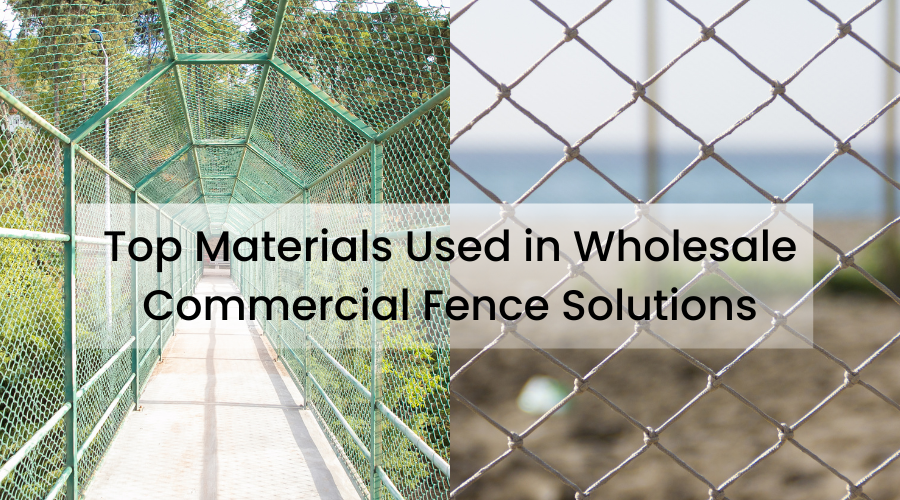
Chain-link fencing is considered one of the most popular commercial fencing materials worldwide. It is manufactured with interwoven steel wire shaped into a diamond-pattern mesh. The mesh is stretched between steel posts embedded in the ground. This fencing comes in different heights, wire gauges, and mesh opening lengths to suit security and usage options.
Chain link has plenty of reasons to be popular. It is cheap, robust, smooth to set up, and needs minimal maintenance. It is crystal clear, and thus it does not hinder view, a plus in the environment where line of sight is valued in the security control.
Normal chain-link fencing consists of galvanized steel with basic corrosion resistance. When the environment is harsher or requires greater visual appeal, vinyl-coated chain-link can be purchased in black, green, or brown. The coating enhances resistance to corrosion as well as a more refined appearance of the fence that can be integrated into the landscaping and architectural styles more easily.
Chain link is frequently one of the most economical commercial-scale wholesale sources of fence materials for businesses and contractors. The cost per linear foot from a good commercial fence distributor is competitive, installation is easy, and the product offering covers a wide range of specifications.
Steel is the most appropriate material when security is paramount. Steel fencing panels and railings are far more reliable than chain-link and offer a much greater degree of physical containment against intrusion. Anti-climb steel designs, welded steel panels, and tubular steel rails are also very popular in high-security commercial applications.
Data centers, government buildings, utility infrastructure, warehouses, and any other commercial location where unauthorized access is a major threat are enclosed with steel fencing. The hardness and the strength of steel render it very hard to cut, bend, or drive through without special tools.
Welded steel fencing panels comprise welded steel wire or steel bars at every intersection. This forms a powerful, solid panel that is impact- and climbing-resistant. Pressed steel, also known as palisade fencing, uses vertical steel pales with rounded or pointed tops fitted into horizontal rails. High-security Palisade fencing is a traditional option that is difficult to climb and provides strong visual privacy.
After fabrication, most commercial steel fencing has been powder-coated. Powder coating uses a dry colored powder, which is electrostatically deposited and cured in order to give a smooth, hard finish. This coating keeps the steel dry and free of rust and corrosion, adds color choices, and the finish makes the fence look professional, which lasts for many years of outdoor exposure.
A good bulk commercial fence exporter shall provide steel fencing with quality powder coating that meets commercial durability standards. A poorly applied coating easily peels off, and the steel under it corrodes.
Aluminum fencing is currently being used more widely in commercial settings where good looks, low maintenance, and corrosion resistance are considered. Aluminum does not easily rust. It is also able to stand the test against corrosion without having to be painted or covered, unlike steel. This would make it a good selection for locations along seashores, in high-rainfall areas, or any other place where moisture is a permanent concern.
Aluminum fencing is lighter than steel but is also a strong, attractive perimeter solution. It is popular in commercial buildings, office complexes, educational institutions, hotels, and recreational organizations where security is medium-high, and appearance is significant.
Aluminum's suitability for decorative use is one of its strengths. Aluminum is extruded into a wide range of profiles and shapes. Aesthetically pleasing aluminum fencing- classical rail with pickets gives a high-end look that can hardly be replicated by steel or chain fencing. On the one hand, ornamental aluminum is a good option because it is part of the building image for commercial property, and on the other hand, it serves a practical purpose.
Aluminum fencing is also normally powder-coated just like steel. Black is the most popular trade color, suitable for numerous building and landscape applications. Other colors can be used in order to suit certain branding or design needs. Since aluminum doesn't rust, the powder coating on the fencing is mainly cosmetic and likely lasts longer than on steel.
Welded wire mesh, or rigid mesh as it is sometimes known, consists of panels of welded steel wire mesh that are much more rigid and difficult to bend than chain-link. The panels are attached to posts and form a clean, flat surface that makes them hard to climb and provides good visibility across the fence line.
This fencing is very common in schools, sports grounds, industries, and commercial grounds, where security, durability, and appearance are matched. Its hard panel shape makes it difficult to cut or push through, unlike the standard chain-link.
Most welded wire mesh sheets used in business operations have anti-climb characteristics. Fences that have narrow aperture panels, i.e., the holes of the fences are so tiny that they cannot be used, as they cannot serve as a foothold. The rigidity, limited apertures, and height make welded mesh fencing a good mid-level security barrier between chain-link and a sturdy steel palisade.
Concrete and masonry fencing are types of fencing material that render the highest permanence as well as physical resistance. Commercial applications that require the highest level of privacy, security, and noise reduction use precast concrete panels, concrete block walls, and brick perimeter walls.
Prison facilities, heavy industry, warehouses, and high-value commercial buildings are among the locations where concrete perimeter fencing would be installed, where unauthorized entry is not allowed under any circumstances. The concrete is nearly impossible to crack without some bulky machinery and is absolutely visually private.
In addition to security, concrete and masonry perimeter fencing is a good noise barrier. Commercial buildings near highways, industrial areas, or other noise sources have solid perimeter walls that minimize sound reaching the interior of the site. This applies especially to hospitality establishments, residential developments adjacent to commercial developments, and 24-hour logistics centers.
Timber fences are rarely used in high-security industrial or commercial facilities. However, it is still applicable to some business purposes. Timber fencing is a common feature in garden centers, farm shops, rural commercial properties, and hospitality locations with outdoor spaces, due to its natural aesthetic and the coziness it adds to a much-outside setting.
The commercial outdoor fencing is made of pressure-treated timber. Preservative chemicals are forced deep into the wood as the treatment process helps to prevent rot and insects, as well as moisture damage. When well-treated, timber fencing can last for many years when maintained periodically.
Timber would need more constant care than the alternative, made of metal or concrete. It must be checked on a routine basis to determine rot, damage, and structural weakness. On-ground posts are highly susceptible to ground deformation due to moisture and contact with the ground. Where large-scale commercial outlets or high exposure to weather are involved, timber has higher maintenance needs, which should be considered in the overall ownership expenses.
Each commercial fencing project possesses a set of requirements. The type of material most suited depends on the security level, budget, the material's ability, looks, or environmental conditions. The needs in a construction site perimeter are not the same as those at a hotel entrance. A school playground does not demand such a fence as a utility substation.
The effort to ensure the requirements are clearly defined, followed by a choice of material, will yield better results and save the cost of an inappropriate fence chosen too early. The best solution is to enlist the help of a skilled commercial fence exporter who is knowledgeable about various materials and how they react to specific conditions when it comes to matching the appropriate material to the particular needs of a given project.
Using a bulk commercial fence exporter to source fencing materials offers obvious benefits to contractors, developers, and procurement teams working on large-scale projects. This is achieved through bulk purchasing, which results in a low unit cost. Having one single source of supply would guarantee a uniform quality throughout the project. An excellent bulk commercial fence enterprise will also provide technical support, product certification, and an authentic delivery schedule to keep projects on schedule.
Having a supplier specializing in commercial fencing offers a wider product selection, more expertise, and a better understanding of the specific requirements and standards for commercial fencing projects.
Everything depends on the material to be used in commercial fencing, the material's properties in providing security and maintenance needs, the fence's appearance, and overall cost relative to the fence's service life. Knowing the advantages and disadvantages of each material enables one to select the appropriate solution for any business location.
Good-quality, solid fencing is essential to commer
READ FULLPeople love to beautify their homes, and if it brings extra protecti
READ FULLWhen a chain link fence fails, most people blame the wire. They shou
READ FULL